
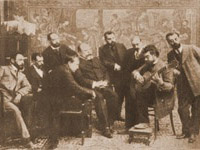
Guitar Lesson
After hearing Starker play the ‘cello suites, I gave up playing them on guitar. The guitar is too weak, I thought.
Then I heard Gerwig play them on the lute and they were beautiful.
How can this be, I thought. The lute is weaker than the guitar.
Then I realized something. Gerwig wasn’t trying to match or compete with the ‘cello. Instead, he played the music to reveal what is beautiful about the lute.
Hauser
Frank Wallace playing a 1939 Hauser. Great sound. Here’s the description from the video.
About the guitar, contact Aaron Green: http://aarongreenguitars.com or http://www.thespanishguitarworkshop.com. Recordings and sheet music by Frank A. Wallace: http://gyremusic.com/; concert information: http://www.frankwallace.com
In my capacity as a dealer I’ve had the pleasure of getting to represent a fair number of Hauser I guitars. I never cease to be amazed at the quality of balance these guitars possess. Not just in the response across the fingerboard but the balance of qualities within the voice of the guitar. When I think of the “Hauser sound” that is the quality that I am thinking of as every one of his guitars I’ve had was unique and ranged from one end of the spectrum to the other in terms of the character of voice. But that aspect of balance remains a constant.
This particular Hauser is a Llobet model, based on the Torres owned by Miguel Llobet, studied by Hauser on a couple of occasions, including the famous meeting with Segovia where he examined Segovia’s Manuel Ramirez. It is somewhat lesser known that Hauser developed both his Segovia model and his Llobet model pretty much concurrently. And Hauser’s favorite guitars were his Llobet model instruments.
One very unique aspect to this 1939 Llobet is that it features a silver tornavoz. It is the only one I’ve handled and is a feature that is found on the Torres original. Albeit Hauser utilizes it differently than Torres did.
There’s not much to say about the sound that isn’t easily heard in Franks capable hands. What I will say is that the guitar is stunningly alive and responsive. It is a joy to play in every way and if I could, I’d keep this one for myself.
This guitar is currently being offered for sale. Any inquires may be sent to me at aarongreenguitars@gmail.com.
Per
Bach: Prelude No. 1 from Kleine Preludien Für Klavier BWV 924 in C-Major. Arranged and played by Per-Olov Kindgren. This is the first time I’ve heard this piece on guitar. Nice going, Per!
‘Cello Prelude on Handpans
This Bach ‘cello prelude is a great favorite with classical guitarists. I think you’ll be interested to hear and see it done on handpans.
Mario
Orange Tree in Flower (1944)
Lyrics by: Homero Exposito
Music by: Virgilio Exposito
Era mas blanda que el agua,
que el agua blanda,
era mas fresca que el rio,
naranjo en floor…
Y en esa calle de estio,
calle perdida,
dejo un pedazo de vida
y se marcho…
Primero hay que saber sufrir,
despues amar, despues partir
y al fin andar sin pensamiento…
Perfume de naranjo en flor,
promesas vanas de un amor
que se escaparon en el viento…
Despues, que importa el despues?
Toda mi vida es el ayer
que me detiene en el pasado,
eterna y vieja juventud
que me ha dejado acobardado
como un pajaro sin luz.
Que le habran hecho mis manos?
Que le habran hecho
para dejarme en el pecho
tanto dolor?
Dolor de vieja arboleda,
cancion de esquina
con un pedazo de vida,
naranjo en flor..
She was softer than the water,
than the soft water,
she was fresher than the river,
orange tree in flower…
And in that summer street,
lost street,
she left a piece of life
and she left…
First you learn to suffer,
then to love, then to leave,
and finally to walk without thinking…
Scent of orange blossoms,
empty promises of love
that escaped in the wind…
After, does it matter the afterwards?
All my life is the yesterday
that stops me in the past,
eternal and ancient youth
that has left me unnerved
like a bird in the dark.
What have my hands done to her?
What have they done to her
to leave me in the chest
so much pain?
Pain of an old grove,
street corner’s song
with a slice of life,
orange tree in flower…
Delpriora: Etude 10
“From an old cassette tape of a live performance. An etude for scales in contrary motion accompanied by opens strings. Middle section: bars and trills.” -Mark Delpriora
Fantasy on a Canadian Folksong
Fantasy on a Canadian Folksong by Jeffrey McFadden (2018), performed by the composer. Recorded March 27, 2019 at St.Mary Magdalene Church, Toronto, by Drew Henderson. Guitar by Marcus Dominelli (2019).
Nice, eh?